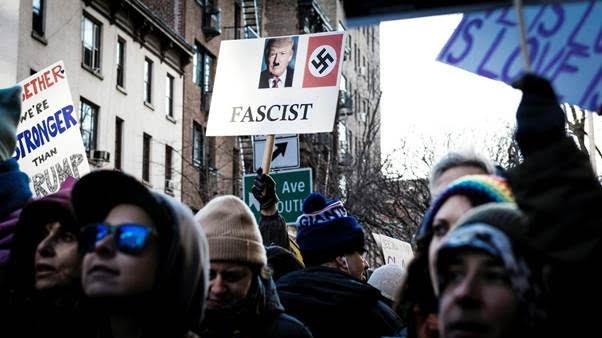
For a snapshot of the authoritarian era to which today’s launch of Unwritten Lives is a response, we don’t have to rewind too far, just to the recent past, to moments that still reside fresh in recent memory.
I recall one such moment precisely. It occurred nine years ago, on 16 June 2016. I was driving on a busy motorway between Dubai and Muscat when the news on the radio announced the killing of the British MP, Jo Cox, earlier that same day. The news of Cox’s murder had a profoundly disturbing effect on me, with no let-up in the days to come. With the Pretoria riots on 21st followed by the Brexit referendum on 23rd, there was, for me, an overwhelming feeling of doom that June, a sense that the world had shifted, and would never be the same, prompting me to write: My imploding worlds.
Six months later, on December 16, 2016, unprecedented legislation followed in the UK. On that day, the extreme right wing group, National Action, became the first neo-Nazi fascist group ever to be banned in the country.
The proscription of the group followed Cox’s tragic murder, a heinous act not only borne out of extremist political views, but also ultra-violent misogyny. She was shot with a sawn-off rifle and stabbed with a dagger by the white supremacist neo-Nazi extremist, Thomas Mair, who shouted “Britain first, this is for Britain,” as he launched his ferocious and cowardly attack on the 41-year-old mother of two.
Investigations into Cox’s murder revealed that during the 1980s, her killer had made contact with Alan Harvey, the editor of the racist pro-apartheid magazine, the South African Patriot. In letters to Harvey, Mair expressed his view that “the greatest enemy of the old Apartheid system was not the ANC and the Black masses but White liberals and traitors.” He also expressed his hope that “the White Race will prevail, both in Britain and South Africa.”
In a letter dated 2 August 1988, Mair sent Harvey ten pounds for a subscription to the magazine. In the letter, Mair also expresses admiration for a BBC interview with Professor Johan Schabort, founder of the neo-Nazi organisation, the BBB, itself the first white supremacist organisation to be banned by the apartheid government.
In addition to the BBB, Schabort had also established the Department of Biochemistry at the Randse Afrikaanse Universiteit (RAU), although, even today, twenty years after the institution’s transformation into the University of Johannesburg (UJ), Schabort’s ties to the BBB are not made clear in the history of the department on the university’s website.
Links between universities and racist organisations are not a uniquely South African phenomenon. The academic establishment has long promoted racist theories, not just in institutions tied to Afrikaner nationalism, but also in Europe’s most prestigious centres of higher learning, as evidenced recently by the University of Edinburgh’s July 2025 Race Review, an indictment of the institution’s links to racism and slavery. In March 2025, the American author and philosopher, Jason Stanley, left Yale University, and moved to Canada. Stanley is the author of two books on fascism: How Fascism Works: The Politics of Us and Them, and Erasing History: How Fascists rewrite the Past to Control the Future. In his essay, "Why I Fled Trump’s America", he describes the crisis at Columbia University as “the capitulation of American universities to fascism.” The crisis in academia is not limited to the US. In the UK, Sheffield Hallam University blocked research into human rights abuses following pressure from China.
The Italian author, Umberto Eco, is perhaps most famous for his first novel, The Name of The Rose, later adapted into a film by the same name. Thirty years ago, on 25 April 1995, Eco gave a lecture on Ur-Fascism, or Eternal Fascism, in which he identified the fourteen eternal features of fascism, warning that “We must keep alert … Ur-Fascism is still around us, sometimes in plainclothes … Ur-Fascism can come back under the most innocent of disguises. Our duty is to uncover it and to point our finger at any of its new instances—everyday, in every part of the world.” It is today a wincing paradox that Eco gave his lecture at a symposium organised by Columbia University.
The banning of the BBB in South Africa in 1988 and National Action in the UK in 2016 has not stemmed the tide of right-wing extremism. Neither has it secured the future of democracy. On the contrary, the return of fascism is no longer a theory, but a reality. On 27 August 2025, the American journalist and historian, Garrett Graff, wrote: “The precise moment when and where in recent weeks America crossed that invisible line from democracy into authoritarianism can and will be debated by future historians, but it’s clear that the line itself has been crossed.”
Two weeks later in the UK, on Saturday 13 September 2025, a far-right rally in London, estimated to be the largest of its kind in decades, drew more than 110,000 people. Billed the “Unite the Kingdom” rally, it was organised by far-right activist, Stephen Yaxley-Lenon, also known as Tommy Robinson. The owner of X, Elon Musk, now the world’s first half-trillionaire, addressed the crowd via live video link. Musk’s message threatened that “violence is coming” and “you either fight back or you die”. He also called for “a change of government in Britain” and the “dissolution of parliament”. According to the police, there were 25 arrests and 26 police officers were injured.
Yet the government’s response was slow and insufficient. It was not till Sunday morning that Peter Kyle, at the time business and trade secretary, said that the rally “doesn’t disturb me because it’s actually proof that we live in a country where free speech, free association, is alive and well”. He went on to say, “The bit that disturbs me is when a minority go to the extreme and end up perpetrating violence against the police.”
Kyle’s response typifies that of a British establishment that cannot identify, let alone confront racism; an establishment that has always sought to underplay racism and far-right extremism in the UK. What are the citizens of a multicultural society such as this to make of a scenario in which a Labour government minister points to a far right rally as a healthy example of free speech, thus echoing the precise argument used by right wing activists to bring credibility to their cause and camouflage their racist conspiracies—that they are protesting in support of supposed free speech? What security are citizens of such a society to find when the only thing that disturbs a government minister about the largest far right rally in decades, is violence against the police? As for the prime minister, Keir Starmer, he only spoke out on the Sunday afternoon, after MPs and anti-fascist groups urged him to do so. And when he did eventually speak out, he seemed to be defending the flag more than he was defending people.
In the face of inadequate responses from Kyle and Starmer, it was the UK’s longest-serving female MP, Diane Abbott, and the Mayor of London, Sadiq Khan, who issued the most strident responses. For Abbott, the rally was “racism, pure and simple … the only (political march) where I actually felt threatened.” Khan, who argued that “our politicians and pundits have refused to condemn the rising tide of hatred in this country”, called on Londoners to reject Trump’s “politics of fear.”
Musk’s threat of violence at the rally, his disregard for democracy, and his unlimited resources—he spent $290M on the 2024 US election—coalesce into a chilling mix, which has had further consequences. In October 2025, less than a month after the rally, he led the campaign against the Jewish advocacy and anti-hate group, the Anti-Defamation League (ADL), calling it a “hate group”. Musk’s campaign culminated in the FBI severing its ties with the ADL. The ensuing right-wing backlash against the organisation also culminated in the ADL deleting its Glossary of Extremism and Hate. The glossary contained more than a thousand entries cataloguing information on racist, antisemitic, and hateful groups and ideologies.
At the centre of this technological fascism is the far-right blogger, Curtis Yarvin, also known as Mencius Moldbug. Yarvin, who believes that democracy is done, is the founder of neo-reaction (NRx), or the Dark Enlightenment, a political philosophy that relegates democracy in favour of engineering. Along with Peter Thiel, his ideas helped shape the worldview of US vice president, JD Vance. Once considered fringe, lurking in the dark corners of the internet, Yarvin’s ideas now epitomise Donald Trump’s administration. Men like Musk, Yarvin, and Thiel are not remarkable intellects. In a more equal world, they would simply be racist white men of a certain age, men like Tommy Robinson, who reasonable and thinking people can see for who and what he is. Instead, in the unequal world they preside over, they are the kingmakers, with the Conservatives in the UK bearing their banners. Rather than small boats, focus your attention on super yachts and private jets. They convey the real threat to democracy and our ways of living.
With November 2025 seeing the release of Guillermo del Toro’s new film, Frankenstein, now is an apt time to consider this question from the groundbreaking novel on which it is based, Mary Shelly’s 1818 novel, Frankenstein; or, The Modern Prometheus: “When falsehood can look so like truth, who can assure themselves of certain happiness?”
For Nick Lowles, founder of Hope Not Hate, “this is an exceptionally dangerous moment.” Ideas around multicultural inclusivity that we have taken for granted “even five years ago, are now contested.” In the UK, the banning of National Action almost a decade ago has not stopped the proliferation of hard right views. Let’s reconsider one example, Alan Harvey, the South African white supremacist who Jo Cox’s killer wrote to in the 1980s.
Today, Harvey is based in London. He is an organiser of The Springbok Club, where old white supremacist flags fly, and where you can still read the latest “Rhodesian” news. Harvey’s magazine, the South African Patriot, found a new home in London after the end of the apartheid, referred to as “the end of civilized rule in South Africa” by the editorial team.
In London, the magazine underwent two further reinventions: as the South African Patriot in Exile in 1991, and again as The Imperial Patriot in 2018. These name changes do not reflect a change in stance. The magazine continues to support patriotism, global white imperialism, western leadership and the free market capitalist system while rejecting communism, fascism, liberal political correctness and multicultural societies.
Through its affiliate Patriotic Forum, it encourages its members to support Reform UK, and in Northern Ireland, the Democratic Unionist Party (DUP), and the Ulster Unionist Party (UUP). However, UUP leader, Mike Nesbitt, described English nationalism the “biggest threat” to the union.
Nine years after Jo Cox’s murder, the extremist magazine her killer subscribed to, can now be ordered, no longer from South Africa, but from central London. At £19.00 for twelve issues, subscribing to white supremacist hatred may seem cheap, until you consider the cost to family’s like Jo Cox’s, the blows to British parliamentary democracy when a serving MP is slain on the streets of their own constituency, and how such a slaying reverberates around the world.
The feeling of foreboding I had in 2016 has escalated during 2025, a year which to me has felt more like a century. In November 2025, the world feels very different from twelve months ago. Ten months into Donald Trump’s second term as dictator, I shudder to think of the world three years down the line. While Trump claims to want to make America great again, a POLITICO Poll reveals that almost half of Americans are pessimistic about the future, believing that the best times are behind them. The latest ranking of the country’s passport does little to challenge their pessimism; in October 2025, the power of the US passport sank to an all-time low.
In September 2025, in a piece that now reads almost like prophecy, the British journalist, George Monbiot, described the forces ranged against journalism as the most powerful he had seen in his 40-year career. Just seven weeks later, as Unwritten Lives prepares to go live, BBC is under unprecedented attack from the right. This is a perilous moment for the organisation. As Monbiot wrote: “you cannot speak truth to power if power controls your words … Power is the rock on which truth flounders. It will always have willing enforces: no one ever lost money telling billionaires what they want to hear.” But Monbiot also inspires hope and action: “Something is stirring; something that could become very big – a citizens’ revolt against the propaganda of power. We fight for the day on which the pen beats the wallet.”
At Unwritten Lives, we aim to be part of that fight. Writing is transformative; it can change the world. It stands as a marker, a testimony, a fold in time, a challenge, an act of defiance, and a show of resistance. We welcome you to join us. Please see our friendly and inclusive submission guidelines, and feel free to write to us at submission@unwrittenlives.com.
Related:
BBC in crisis: why did Tim Davie and Deborah Turness resign? | BBC | The Guardian
Panorama - Trump and the Tech Titans - BBC iPlayerPanorama - Trump and the Tech Titans - BBC iPlayer
31 Nobel Laureates Warn: The Signs of Fascism are Here | TIME
The Manifesto of the Anti-Fascist Intellectuals, 100 years later
English - Open Letter Against the rise of Fascism in 2025
Sign the letter here.
 Unwritten Lives uses only essential cookies required for basic functionality.
We do not use analytics, tracking, or advertising cookies.
Unwritten Lives uses only essential cookies required for basic functionality.
We do not use analytics, tracking, or advertising cookies.