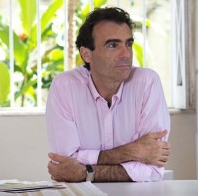
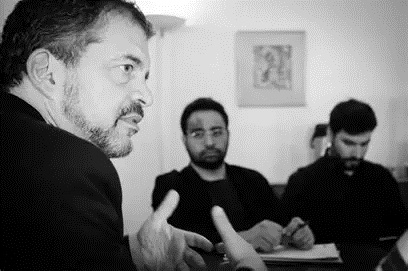
There are men who are arrested because they disrupt, not because they have done wrong. Khayam Turki is one of them. Since February 2023, this Tunisian intellectual, economist and political activist has been wasting away behind the walls of arbitrary detention, accused of a “plot” for which no one has seen any proof, or evidence. His only crime: to think, to speak, to refuse to submit.
A man of the world, between cultures and convictions
Khayam Turki was born in Paris in April 1965, to a Tunisian diplomat father and a Spanish immigrant mother, shaped by her anti-Franco past. Early on, he learned to live between languages, continents and different norms. These diverse roots shaped in him an openness in his intelligence: both analytical and deeply human. A graduate of the Institut des Hautes Études Commerciales in Carthage, Sciences Po Paris, and the American University in Cairo, he embodies that generation of cosmopolitan intellectuals who think about the world openly in order to change it.
I met Khayam in Cairo in 1996. I was then with Médecins Sans Frontières, tasked with opening an office for the Arab world. He was living there with his young family. We crossed paths, then chose each other as friends. In his company, I found a profound sense of justice, a rare lucidity, a quiet humour, and genuine care. A man who doubts, therefore an intelligent man. A man of conviction, therefore a courageous one.
From thought to action: choosing to speak out
After a brilliant career in finance and international development, Khayam could have stayed on the sidelines, safe from risk. He chose instead to engage. In 2011, in the midst of post-revolutionary turbulence, he joined Ettakatol, a progressive party, convinced that a just republic and public ethics remain within reach. To give meaning to the words “social justice”. He advises, unites and engages in dialogue—far from personal ambition. Politics, to him, is not a career; it is a service.
In 2015, true to his principles, he left the party quietly, without bitterness. Ever consistent. He then founded Joussour, a citizen think tank to imagine concrete solutions for Tunisia’s future: differently, freely. As the French philosopher, Edgar Morin, puts it: “To think is already to act—and sometimes, already to resist.”
In 2020, Khayam’s name surfaced as a possible candidate for Prime Minister, supported by parties as diverse as Ennahdha, Au coeur de la Tunisie, and Tahya Tounes. Proof of his credibility and of what authoritarian powers fear most: free minds.
February 2023: the orchestrated fall
At first light on 11 February 2023, they came for him. No clear explanation. No readable warrant. The charges followed: “conspiracy against state security.” An empty phrase but terrifyingly effective in silencing dissent. He was taken to El Gorjani, then transferred to the Bouchoucha barracks. Isolation. No facts made public, no respect for the rule of law or court proceedings. Pressure. Cut off, coerced and blackmailed, yet he refused to yield. They tried to break him. They failed. In his cell, he lives under constant artificial light. He eats cold food. He is denied direct contact with his family under the pretext of anti-terrorism laws. His silence becomes resistance; his endurance, a political act. For a long time, he had no books, no visits. His relatives denounce inhumane detention conditions. And yet, he endures. There is hope.
A dictatorship that dares not speak its name
Khayam Turki’s arrest is not an isolated case: it is a symptom. Since 2021, Kaïs Saïed’s Tunisia has been sinking into a cold, methodical authoritarianism, obsessed with control and repelled by any opposition. Under the guise of “saving the State,” justice, the press and independent voices are gagged. This regime fears debate, critical thought and collective intelligence: so it criminalizes meetings and speech itself. Tunisia, once the beacon of the Arab Spring, has become the laboratory of democratic disillusionment that Europe prefers to ignore. Tunisia is now the backyard of a hesitant Europe. An anxious Europe ready to accept anything to contain migrants, even if it means abandoning a people to their tormentors. France, the European Union, the United States, they watch. They know. But they choose the stability of a despot over the vitality of a democracy. Diplomatic silence becomes political complicity.
Resisting, even in the shadows
Around Khayam, resistance is organising: discreet, but persistent. Family, friends, lawyers, citizens: an invisible yet living chain. Letters, vigils, opinion pieces, gestures of solidarity. Each act is a refusal. Each word, a candle lit in the night. Repression seeks erasure. It fails. Because you cannot imprison free thought, an idea, or silence those who stand upright.
More than a man: a line of resistance
Khayam Turki is not merely a political prisoner. He is a turning point. What is inflicted upon him is inflicted upon freedom of thought, human dignity, and upon the Tunisia that debates, hopes and refuses to bend. His struggle is not his alone. It is the struggle of so many other Tunisian detainees. It is ours: the struggle of all who refuse fear, resignation, and oblivion. In the face of a state’s brutality and the cynicism of diplomacy we still have our words, our memory, and our vigilance. There is no chance of silencing or forgetting: we are here.
We keep watch. And we will speak, always.
Related:
Tunisia: Arbitrary Detention Crushes Dissent | Human Rights Watch
Affaire Khayem Turki …ce qu’a dit la presse française
La période de détention de Khayam Turki prend fin mardi | Tunisie Tribune
L’arrestation de Turki et Jelassi en lien avec le dossier Letaief ?
En Tunisie, ouverture d’un procès hors norme pour « complot contre la sûreté de l’Etat »
Who are Tunisia’s political parties? | Features | Al Jazeera
Tunisia government structure and political parties. | - CountryReports
The Challenge of Complexity: Essays by Edgar Morin on JSTOR
Edgar Morin, "Cheminer vers l’essentiel" : Ce que résister veut dire - La Grande Librairie
EDGAR MORIN : « Pour moi, résister est un mot très actuel | «revue entre

 Unwritten Lives uses only essential cookies required for basic functionality.
We do not use analytics, tracking, or advertising cookies.
Unwritten Lives uses only essential cookies required for basic functionality.
We do not use analytics, tracking, or advertising cookies.